пятница, 9 октября 2020 г.


2 курс

Education in the Russian Federation. 


Match the beginning of the proverb in column A with its ending in column B.

1.

Live and…

A.

…a dangerous thing.

2.

Knowledge is…

B.

…to learn.

3.

A little knowledge is…

C.

…power.

4.

It is never too late…

D.

…to know nothing.

5.

To know everything is…

E.

…learn.

6.

There is no royal road…

F.

…to learning.

Find Russian equivalents. 

Век живи, век учись!

Знание-сила!

Недоученный хуже неученого!

Учиться никогда не поздно!

Знать все значит ничего не знать!

В учебе нет легких путей!

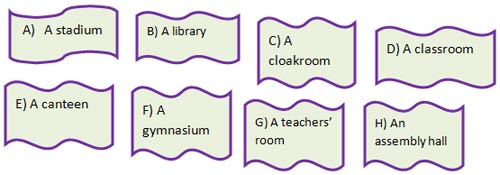
Guess the room:

  1. Books, newspapers, magazines are kept there. You go there to borrow or read books.
  2. A room where you have lessons at school.
  3. Meetings, performances, gatherings and parties are held in it.
  4. A place where you can watch sports matches.
  5. You can leave your coat or bag there.
  6. A room where you do exercises for your body.
  7. A room where you can eat sandwiches and drink tea or juice during the break.
  8. A room for teachers and class registers.


hometask

Test yourselves. Which statements refer to schools in Russia (R) and which ones to schools in Britain (B). 

1.

Some boys and girls study in separate schools.


2.

The right to education is guaranteed by the Federal Law.
(Article 5)


3.

Every school has a core curriculum and a school curriculum.


4.

Students have prayers at 8.50. a. m.


5.

Students have 5 lessons in the morning and 2 after lunch.


6.

Lessons begin at 8 a.m. and last to 1 or 2 p. m.


7.

One of the subjects is Religious Instructions.


8.

One of the subjects is Ethnography.


HT is to be ready with topic about Education in the Russian Federation.

1 курс тема: "ГЛАГОЛ TO BE" Present Simple, Past Simple, Future Simple


example


      Упражнения выполнить письменно в тетрадях к следующему уроку 17.10

№1. Поставьте в пропуски необходимую форму глагола to be:

 I ( ) glad to see you.

You ( ) our best friend.

 He ( ) an excellent driver.

 Ann ( ) a perfect housewife.

 We ( ) ready for hard work.

 It ( ) a green dress.

They ( ) our best employees.

 My friend and I ( ) divers.

 It ( ) spring. I ( ) busy.

She ( ) responsible for children. (несет ответственность за детей).

 Mr. Osipov ( ) the Director of Department.

It ( ) cold autumn.

 These things ( ) dangerous.

 These products ( ) expired. (Эти продукты просрочены).

№2. Переведите на английский язык:

Он сейчас занят.

Эти люди опасны.

Погода прекрасная.

Эта рубашка старая.

Это наши лучшие друзья. 

Они рады видеть вас.

Это мой старый автомобиль.

Вы прекрасный собеседник.

 Они серьезно больны.

№ 3  Переделайте эти утвердительные предложения в отрицательные:

She is happy. His computer is old. Vera is his wife. They are his sons. It ‘ cold today. Ответы: She is not happy. His computer is not old. Vera is not his wife. They are not his sons. It ‘not cold today.

 №4.  Переведите предложения:

 Они не студенты. Я несчастлив. Эти люди не рады видеть вас. Мой отец не миллионер. Эти новости мне неинтересны. Сегодня не холодно. Он сейчас не занят (свободен). Мы сейчас не в Москве. Этот отель некомфортабельный. Он не водитель, он механик.

№ 5. Поставьте  глагол to be в необходимой форме:

 ( ) your father a doctor? ( ) you in office now? ( ) they new employees? ( ) I happy? ( ) Mr. Orlov busy? 

№ 6. Переведите на английский язык: 

Погода хорошая? Вы в порядке? (all right). Этот фильм интересный? Ты сейчас в Лондоне? 

  № 7. Употребите правильную форму глагола to be:

I ( ) your friend.

They ( ) our neighbors.

She ( ) my wife.

These dresses ( ) better than those.

 We ( ) talented people, ( ) we?

 ( ) you busy?

( ) he in the office?

This ( ) a difficult task.

There ( ) many rooms in the house.

 № 8. Переведите на английский язык предложения:

Это новая машина.

 Это старые деревья.

Они молоды и счастливы.

Мне 40 лет.

Его жене 35 лет.

 Он в офисе?

 Вы заняты?

  № 9. Найдите ошибки в употреблении глагола to be: замените, поставив его, там, где необходимо, и в верной форме:

Is you at home?

Are they friends?

His uncle are a chief engineer.

Are she 45?

The weather is not fine.

Those boys talented dancers.

 What your name?

The children‘s hands is dirty.

My new dress red.

Are your father a teacher?

   Вставьте глагол to be в нужном времени. (Present Simple / Past simple /  Future Simple)

Present Simple

  1. Fred _____ thirteen now.
  2. «____ you English? «No, l _________.
  3. Her name _____ Ann.
  4. «______ David a good friend?» «Yes, he _______».
  5. __________ these men doctors?
  6. «You_______ from Belarus, _________ you?» «Yes, that______right».

Past Simple

  1. «When you ________ a small child, _________ you happy?» «Yes, I ________. I ________ very happy.»
  2. They (not) ________ ready for the  lesson last Tuesday.
  3. The days_________ cold and wet last September.
  4. There ________20 pupils in our class last year.

Future Simple

17. He ________ 13 years old tomorrow.

18. I ________ back home at 6 o’clock.

19. We __________ at the library at that time.

20. They __________ here at 3 o’clock.

21. They ________ happy to see us.

Упражнение . Complete what Brenda says about herself on the picture. Use am,  is or are.

My name (1) ______ Brenda Foster. I (2)  ______ on the left in the picture. I (3) ______  ten years old and I (4) ______ in the fifth form. My birthday (5)  _____ on the first of January. I (6) ______  from Santa Monica, California, USA. I (7) ______ American. My phone number (8) ______ 235-456-789. I live at 16 Park Street. My post code (9) ______ LA 30 SM. I’ve got a sister and a brother. Their names (10) ______ Gina and Paul. Gina (11) ______ 16 years old and Paul (12) ______  only three. I’ve also got a dog. His name (13) ______ Spot. He (14) ______  on the right in the picture. My Mum (15) ______ a doctor. She works at a hospital. My Dad (16) ______ a driver. He works in Los Angeles. We (17)  ______ all   friendly in our family.

 Упражнение . Write in is / isn’t, are / aren’t, am / ’m not.

  1. I __________ lazy.
  2. My friend ___________ naughty.
  3. My granny___________ kind.
  4. My granddad ___________clever.
  5. My teachers___________ funny.
  6. I___________ a bad pupil.

 Упражнение . Fill in is, are, He’s, She’s, l’m, They’re.

  1. How _____ your mum? — _______ fine, thanks.
  2. How _____ your parents? — _____ OK.
  3. How _____ you? — _____ very well, thank you.
  4. How _____ your uncle? — _____ fine, thanks.
  5. How _____ your children? — _____ OK.
  6. How _____ Liz? — _____ fine, thanks.
  7. How _____ your cousin? — _____ very well, thank you

 Упражнение . Write in am /’m not, is / isn’t or are / aren’t.

  1. I _____ a businessman.
  2. I _____ a pupil.
  3. My friends_____ teachers.
  4. My uncle_____ a driver.
  5. My parents _____ doctors.
  6. My cousins _____ vets.
  7. My mum _____ a shop-assistant.


.


понедельник, 5 октября 2020 г.

Предлоги времени в английском языке: at, in, on


Предлог at в английском языке

А вот несколько правил употребления предлога at:

  1. С конкретными моментами времени: at 6 o’clock (в 6 часов), at midday (в полдень), at midnight (в полночь), at the moment (сейчас).
  2. I heard a strange noise at midnight. – В полночь я услышала странный звук.

    Однако стоит обратить внимание на то, что в некоторых случаях мы все же используем предлог in, говоря о ночи:

    • С выражением in the middle of…
    • I woke up in the middle of the night when I heard my dog barking. – Я проснулась среди ночи, когда услышала, как лает моя собака.

      Когда речь идет о какой-либо определенной ночи.

          I had a fever in the night and had to take medicine. – Ночью у меня была температура, и мне пришлось принять лекарство. (здесь мы говорим о конкретной ночи, а не о времени суток в целом)

      1. Когда говорим о начале и конце периода: at the beginning (в начале), at the end (в конце).
      2. She is moving in at the beginning of January. – Она въезжает в начале января.

        НО! Мы говорим in the end в значении «в конце концов», «в конечном счете».

        In the end, it doesn’t even matter what he thinks. – В конечном итоге не имеет значения, что он думает.

      3. Короткие периоды, связанные с праздниками или выходными: at Easter (на Пасху), at Christmas (на Рождество), at the weekend (на выходных).
      4. I will go abroad at the weekend. – На выходных я поеду за границу.

      5. Со словами, обозначающими время принятия пищи: at breakfast (за завтраком), at lunch (за обедом), at dinner (за ужином).
      6. Didn’t you eat enough at breakfast? – Ты что, не наелся за завтраком?

      Предлог in в английском языке

      Приведем список случаев, когда используется предлог in:

      1. C длительными периодами времени. Например: времена года (in winter – зимой), месяцы (in October – в октябре), года (in 1967 – в 1967), десятилетия (in the 1990s – в 1990х), столетия (in the 18th century – в 18 веке) и другие периоды времени (in the week before Christmas – в течение недели перед Рождеством).
      2. I was born in May. – Я родилась в мае.

        She was in Italy in 1997. – Она была в Италии в 1997.

      3. Когда говорим о времени суток (кроме выражения at night): in the morning (утром), in the evening (вечером).
      4. She usually does cooking in the morning. – Она обычно готовит кушать утром.

      5. Когда говорим о том, сколько времени занимает выполнение какого-либо действия.
      6. I’ve learned this poem just in two hours. – Я выучила это стихотворение всего за два часа.

      7. Если говорим, сколько времени пройдет, прежде чем произойдет действие.
      8. The dinner will be served in 10 minutes. – Ужин будет подан через 10 минут.

      Предлог on в английском языке

      И последний в списке, но не последний по значимости, предлог on.

      1. Когда говорим о конкретном дне недели.
      2. My next lesson is on Friday. – Мой следующий урок в пятницу.

      3. Предлог используется с определенной датой или моментом конкретного дня.
      4. My birthday is on the 16th of May. – Мой день рождения 16-го мая.

        I am meeting my friends on Friday evening. – Я встречаюсь с друзьями в пятницу вечером.

      Когда мы не употребляем предлоги времени

      1. Обратите внимание также на то, что есть ряд слов, перед которыми предлоги не используются. К ним относятся: all (все), any (любой), each (каждый), every (каждый), last (прошедший), next (следующий), one (один), some (несколько), this (это), that (тот).
      2. Сравните следующие примеры:

        She’ll come in the morning. – Она придет утром.
        She’ll come next morning. – Она придет следующим утром.

        See you on Monday. – Увидимся в понедельник.
        I go to the cinema every Monday. – Я хожу в кино каждый понедельник.

      3. Также предлоги at, in, on не используются перед выражениями yesterday (вчера), the day before yesterday (позавчера), tomorrow (завтра), the day after tomorrow (послезавтра).
      4. I had a lot of work yesterday. – У меня было много работы вчера.

      Итак, если вы еще раз внимательно посмотрите на примеры, приведенные в статье, вы обязательно заметите определенную систему в использовании предлогов времени в английском языке. Очень обобщенно можно сказать, что предлог in соответствует наиболее длительным отрезкам времени, таким как десятилетия, года, месяца и т. д. At соответствует наиболее коротким периодам времени. On используется с конкретными днями недели и частями дня.


ТЕСТ
Предлоги времени в английском языке: at, in, on
Выберите правильный вариант
Задание 1.

This building was built ... 1938.

Задание 2.

She is asleep now. She was very tired as she didn’t sleep ... the night.

Задание 3.

I’m having a class ... Tuesday evening.

Задание 4.

What are you doing ... Easter?

Задание 5.

We met ... every Sunday morning to have breakfast together.

Задание 6.

She has finished her report ... just 2 days.

Задание 7.

... his arrival in London, Mr Smith felt ill.

Задание 8.

The film was shown on television ... one morning last week.

Задание 9.

There were many people ... dinner who I had never met before.

Задание 10.

I am having a party ... the end of the week.

  WORKSHEETS PRESENT SIMPLE AND PRESENT COINTINUOUS PAST CONTINUOUS PAST CONTINUOUS PAST PARTICIPLES CROSSWORDS PRESENT PERFECT PAST SIMPLE ...